.png)
What greylag geese can teach us about leadership
- Carolyn Deveney

- May 5
- 3 min read
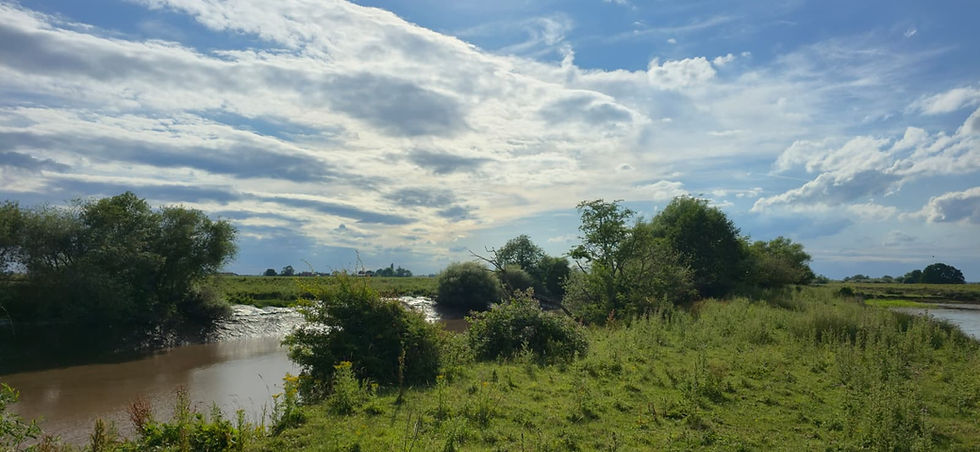
We stood by the river and watched something quietly remarkable unfold.
A large group of greylag geese - eight adults, moving together with around thirty goslings.
At first glance, it looked simple, a family group navigating water and bank, nothing unusual.
But the longer we watched, the more it revealed itself.
This wasn’t random or chaotic movement.
It was organised, attuned and intentional.
Some of the adults stayed close to the goslings, guiding them forward. Others held the edges - front, back, sides - forming a kind of living boundary.

A few positioned themselves slightly apart. Watching.
Not moving the group but protecting it like sentries.
Every role different. Every role essential.
And what struck me most was this:
They weren’t just looking after their young.
They were looking after all of them.
The goslings moved as one.
Not because they were being controlled, but because they were held within something that felt safe enough to trust.
There was no visible panic, or scattering, and no confusion about where to go.
Just steady movement.
Together.
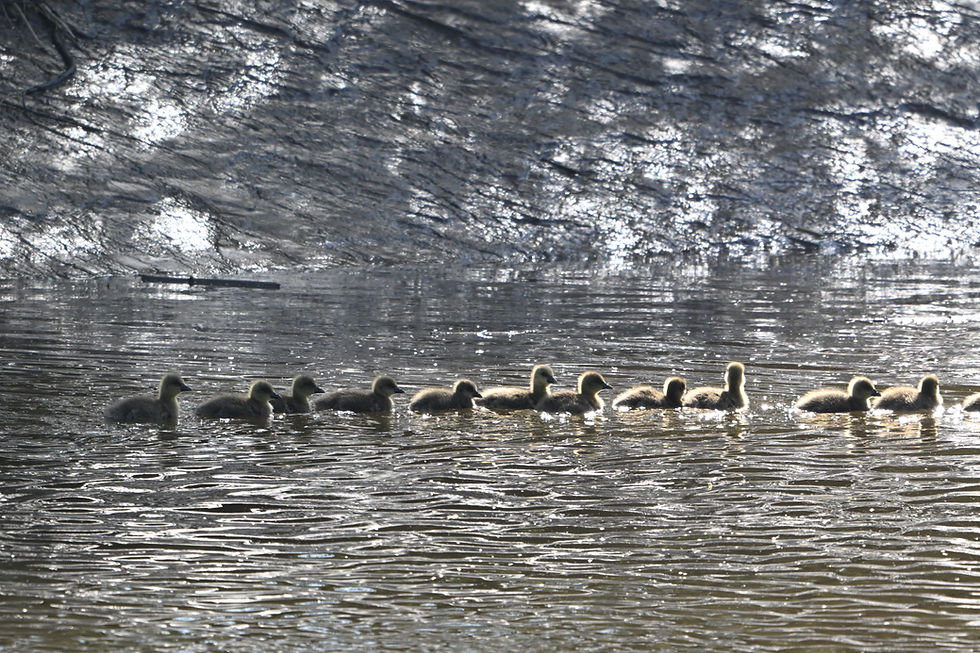
We saw them again the following day, making their way to a nearby pond, and it was the same.
The same quiet coordination. The same shared awareness. The same sense that everyone knew their part - without needing to assert it.
Watching them, it was hard not to reflect on how different this can feel in our own worlds.
In teams, in leadership, and in the way we carry responsibility, we often find ourselves working in silos or feeling the weight of individual pressure. This can lead to disconnection and a lack of shared purpose.
So often, leadership becomes something fixed. Assigned. Held by one or two people at the top.
Responsibility becomes individual. Ownership becomes siloed. Pressure builds in certain places while others step back.
And somewhere along the way, we lose that sense of moving together.
What I saw in those geese wasn’t hierarchy, it was something more fluid.
Leadership that shifted depending on what was needed. Awareness that extended beyond the self. Responsibility that was shared, not divided.
No one goose was doing everything.
And yet, everything was being held.
There was trust in the system.
The goslings didn’t hesitate with every step. They didn’t seem to question whether they were safe.
They moved because the conditions around them allowed them to.

And that feels important, because so often, in our own lives and work, we focus on getting people to move forward - to make decisions, take action, or step up.
But we pay less attention to the environment around them. To whether it feels safe enough to move at all.
In coaching, this shows up in a different way.
Not as direction. Not as instruction.
But as creating the conditions where someone can think clearly, trust themselves, and move forward in a way that feels right for them.
Not because they’re being pushed - but because something around them has shifted enough to make that movement possible.
The same is true in leadership.
Perhaps it’s less about having all the answers, and more about:
Holding the edges - creating a safe boundary for others to move within
Sensing what’s needed - staying attuned to the group and the moment
Stepping forward and stepping back - allowing leadership to move
Trusting the system - believing in the collective, not just the individual
No one was trying to prove anything, no one was carrying it all.
And yet, everything that mattered was being taken care of.
That quiet sense of shared responsibility. Of attuned leadership. Of moving together towards something that mattered.

And it left me wondering:
What might shift if our teams worked like this?
If leadership became more fluid - responding to what’s needed?
If responsibility felt shared - rather than carried?
If people felt safe enough to trust themselves - and simply move?
By embracing these principles, we might create environments where collaboration and trust thrive.
Maybe we have more to learn from the natural world than we realise.
Not in grand gestures.
But in these small, steady, deeply connected ways of being.
If this resonates, you’re very welcome to explore more about how I work, or get in touch for a gentle, no-obligation discovery conversation.


Comments